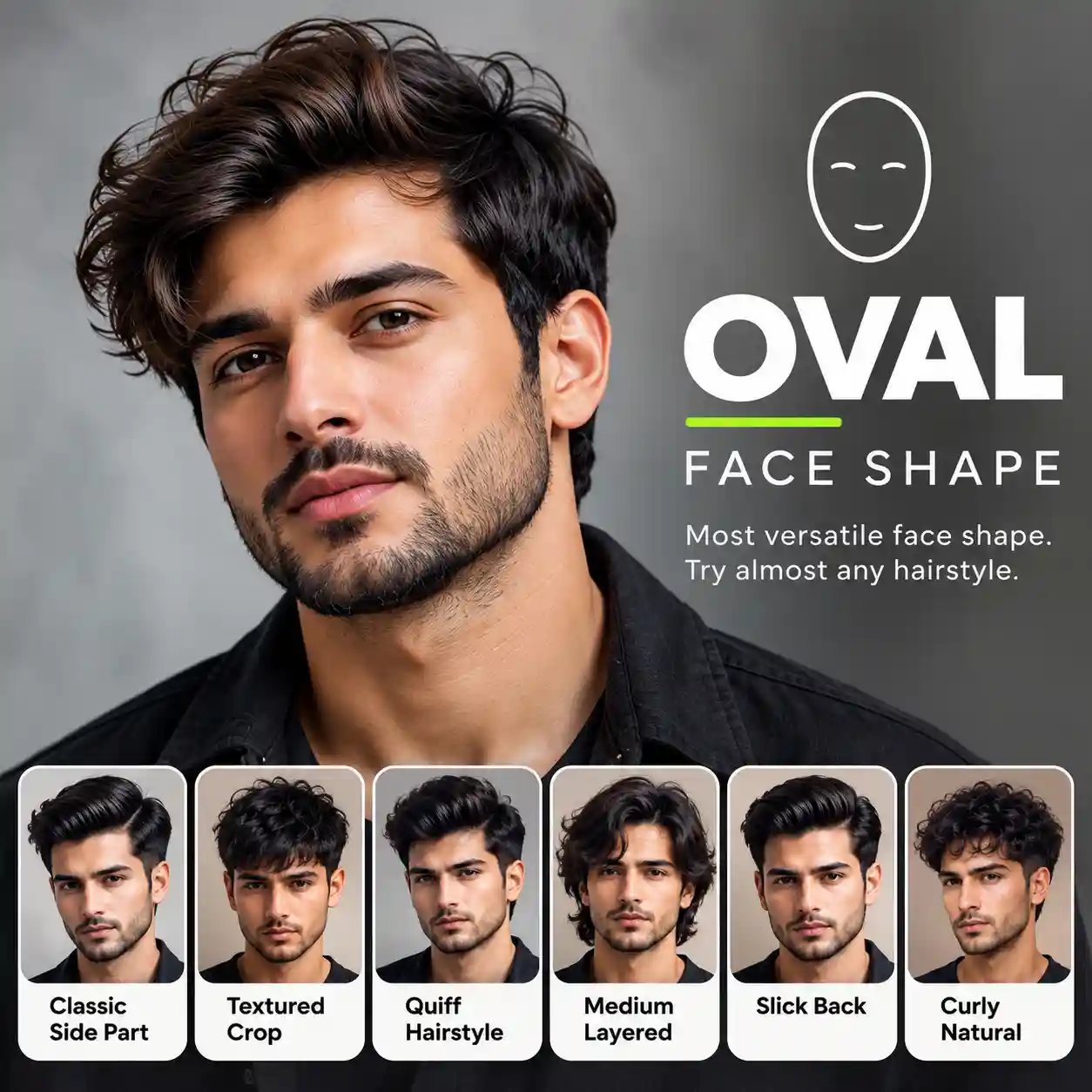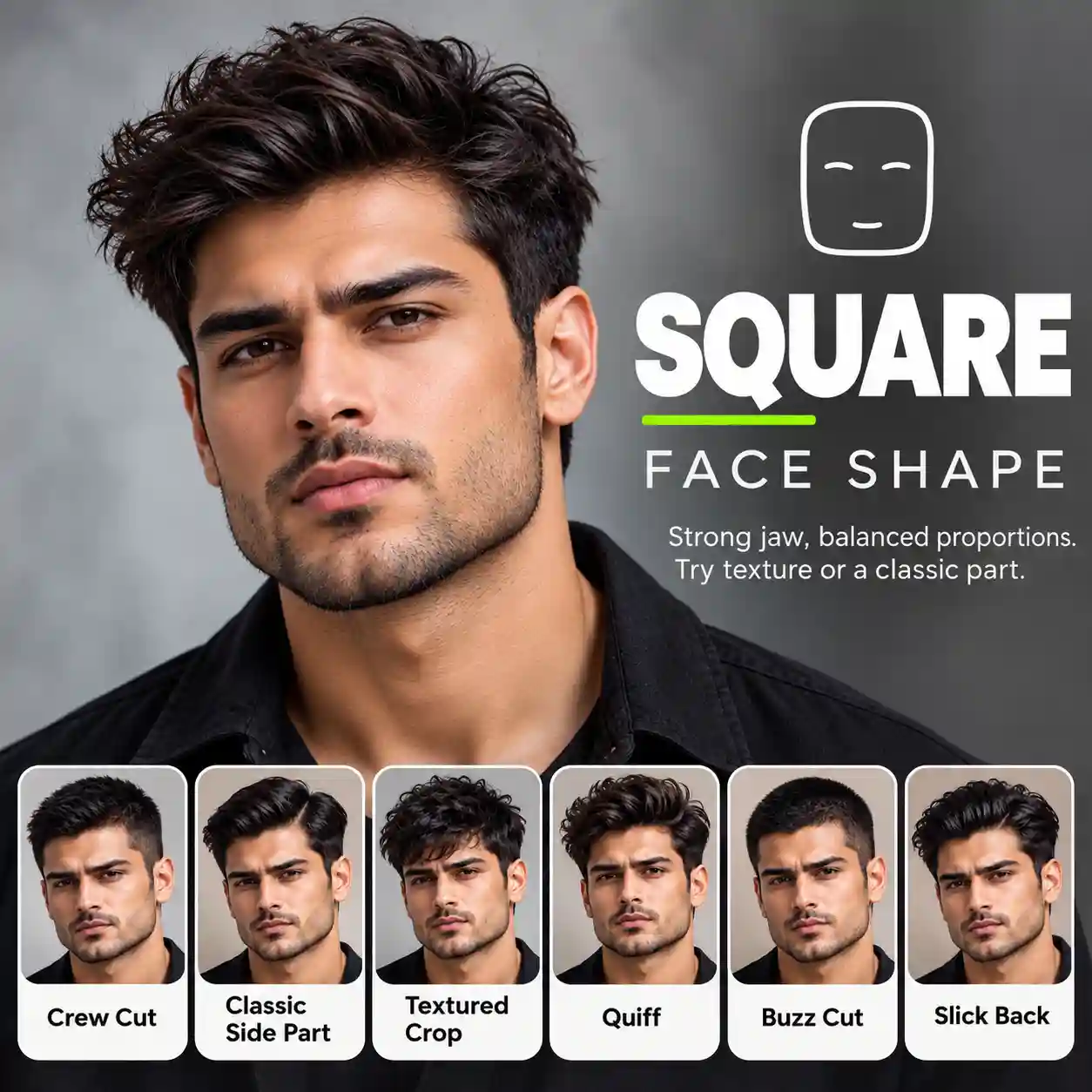
A square facial outline commonly has a pronounced jaw and fairly balanced face width and length. It does not limit you to short fades or slick hair. Textured crops, brushed-back styles, medium waves and longer layers can all emphasize or soften different aspects of your look.
These original hairstyle suggestions cover short, medium and longer square face haircuts. Each image uses an existing Media Library attachment and remains manually editable in the WordPress block editor.
Quick Answer: Best Square Face Hairstyles for Men
Choose a haircut based on your natural texture, how much forehead you want visible and the amount of styling you enjoy. A textured fringe frames the front, a side part offers structure, loose waves add movement and long layers allow more face framing. Face-shape guidelines are options, not rules.
12 Square Face Hairstyles for Men: Names, Photos and Barber Tips
1. Textured Crop Fade

A textured top breaks up a sharp fringe, while the fade gives a clean silhouette.
Barber instructions: Bring a front and side photo of this cut, agree on the fringe length and how high any taper or fade begins. Adjust the layers for your natural hair texture.
Styling: Use a modest amount of product when required, follow your natural growth direction and ask how the haircut looks air-dried.
2. Side Part Undercut

A defined side direction looks polished while retaining contrast near the temples.
Barber instructions: Bring a front and side photo of this cut, agree on the fringe length and how high any taper or fade begins. Adjust the layers for your natural hair texture.
Styling: Use a modest amount of product when required, follow your natural growth direction and ask how the haircut looks air-dried.
3. Slick Back

Sweeping hair backward leaves the face open and works with classic grooming.
Barber instructions: Bring a front and side photo of this cut, agree on the fringe length and how high any taper or fade begins. Adjust the layers for your natural hair texture.
Styling: Use a modest amount of product when required, follow your natural growth direction and ask how the haircut looks air-dried.
4. Medium Waves and Low Fade

Medium natural waves make a softer outline around angular facial features.
Barber instructions: Bring a front and side photo of this cut, agree on the fringe length and how high any taper or fade begins. Adjust the layers for your natural hair texture.
Styling: Use a modest amount of product when required, follow your natural growth direction and ask how the haircut looks air-dried.
5. Medium Pompadour

A pompadour brings height to the front, whether neatly structured or loosely styled.
Barber instructions: Bring a front and side photo of this cut, agree on the fringe length and how high any taper or fade begins. Adjust the layers for your natural hair texture.
Styling: Use a modest amount of product when required, follow your natural growth direction and ask how the haircut looks air-dried.
6. Long Tousled Layers

Longer layers frame the cheeks and jaw without relying on a close fade.
Barber instructions: Bring a front and side photo of this cut, agree on the fringe length and how high any taper or fade begins. Adjust the layers for your natural hair texture.
Styling: Use a modest amount of product when required, follow your natural growth direction and ask how the haircut looks air-dried.
7. Low Fade Quiff

The low fade creates a subtle side outline while the front stays lifted.
Barber instructions: Bring a front and side photo of this cut, agree on the fringe length and how high any taper or fade begins. Adjust the layers for your natural hair texture.
Styling: Use a modest amount of product when required, follow your natural growth direction and ask how the haircut looks air-dried.
8. Faux Hawk Fade

Central texture can add an edgier effect without requiring a sharp mohawk.
Barber instructions: Bring a front and side photo of this cut, agree on the fringe length and how high any taper or fade begins. Adjust the layers for your natural hair texture.
Styling: Use a modest amount of product when required, follow your natural growth direction and ask how the haircut looks air-dried.
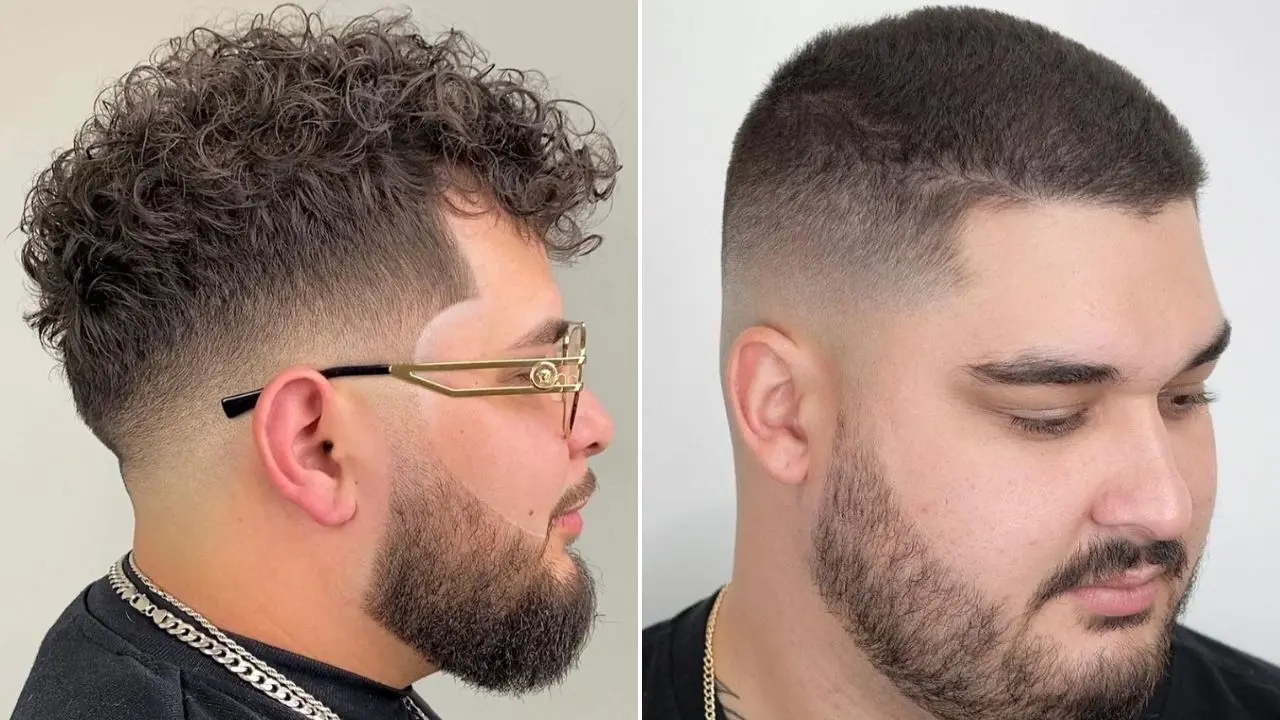
9. Curly Top Fade

Natural curls form texture on top with tidier sides.
Barber instructions: Bring a front and side photo of this cut, agree on the fringe length and how high any taper or fade begins. Adjust the layers for your natural hair texture.
Styling: Use a modest amount of product when required, follow your natural growth direction and ask how the haircut looks air-dried.
10. Curtain Bangs With Taper

A center or off-center part lets longer front sections frame the face.
Barber instructions: Bring a front and side photo of this cut, agree on the fringe length and how high any taper or fade begins. Adjust the layers for your natural hair texture.
Styling: Use a modest amount of product when required, follow your natural growth direction and ask how the haircut looks air-dried.
11. Medium Curly Hair

Medium curls add natural movement at the sides and around the forehead.
Barber instructions: Bring a front and side photo of this cut, agree on the fringe length and how high any taper or fade begins. Adjust the layers for your natural hair texture.
Styling: Use a modest amount of product when required, follow your natural growth direction and ask how the haircut looks air-dried.
12. Long Swept-Back Hair

Long hair worn backward can keep the jawline visible without shortening the sides.
Barber instructions: Bring a front and side photo of this cut, agree on the fringe length and how high any taper or fade begins. Adjust the layers for your natural hair texture.
Styling: Use a modest amount of product when required, follow your natural growth direction and ask how the haircut looks air-dried.
More Hairstyle Inspiration Photos
These additional photos offer more references. You can replace or reorder individual images in Gutenberg.


Short, Medium and Long Hairstyles
Short haircuts offer a compact shape, medium hair allows fringes and part changes, and long hair creates face-framing layers or tied-back styling. Compare short hairstyles, medium hairstyles and long hairstyles.
Hair Types: Straight, Wavy, Curly and Thick
Straight hair reveals the cut outline, wavy hair forms bends and curls may shrink substantially after drying. Thick hair needs different weight management than low-density hair. Browse straight hairstyles, wavy hairstyles, curly hairstyles and thick hair hairstyles.
Professional Hairstyles and Indian Men
For workplaces, consider a natural side part, soft taper or brushed-back style that can be styled consistently. Hair textures vary among Indian men, so the best selection is based on an individual’s hair pattern, hairline and comfort rather than a single stereotype.
Hairstyles With Beard and Without Beard
Facial hair is optional. A beard changes the chin and jaw outline, while a clean-shaven look leaves natural facial features visible. Choose the combination that you prefer and see beard styles for men for grooming ideas.
Face Shape and Barber Consultation
To estimate face shape, compare the forehead, cheekbone and jaw widths and the overall face length in a straight-on view. Real facial proportions overlap categories. Before visiting a barber, save front and side haircut photos with similar hair texture, explain your ideal fringe length and describe your normal morning styling routine.
FAQs About This Face Shape
What hairstyles suit a square face man?
A crop, side part, quiff, medium waves or long layers can work; texture and preference should guide the choice.
Is a fade good for a square face?
Yes. Low, mid and high fades all give different outlines. There is no mandatory fade height.
Do long hairstyles suit square faces?
Yes. Long layered hair or loose waves can frame an angular jaw.
Can men with square faces wear a beard?
Yes. Beards are optional and can change how prominent the jaw appears.
What professional haircut suits a square face?
A tidy side part, swept-back style or soft taper can suit many professional settings.
Explore More Hairstyle Guides
Browse hairstyles by face shape, haircuts for men and hairstyle images for additional references.