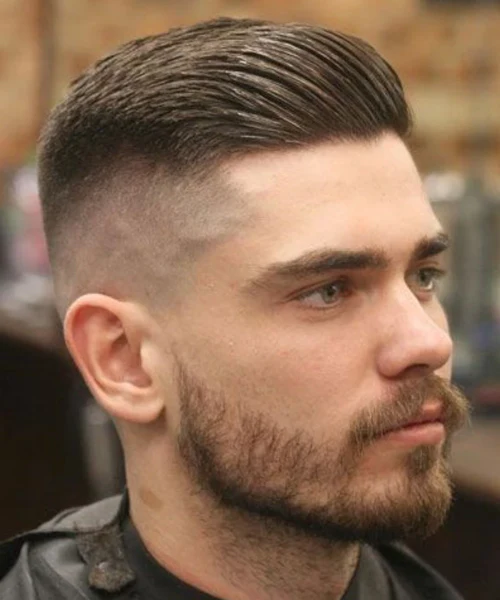
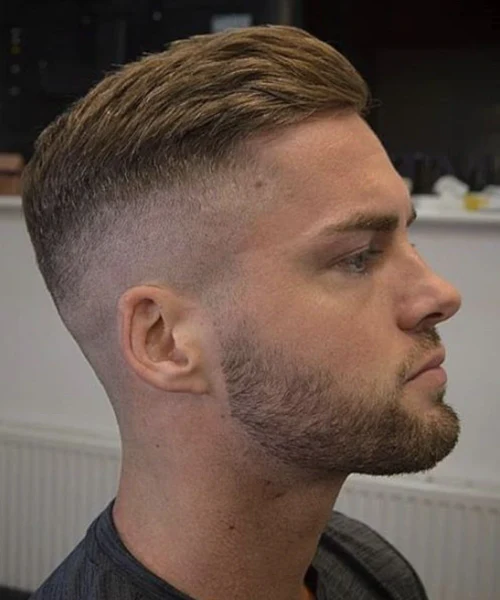
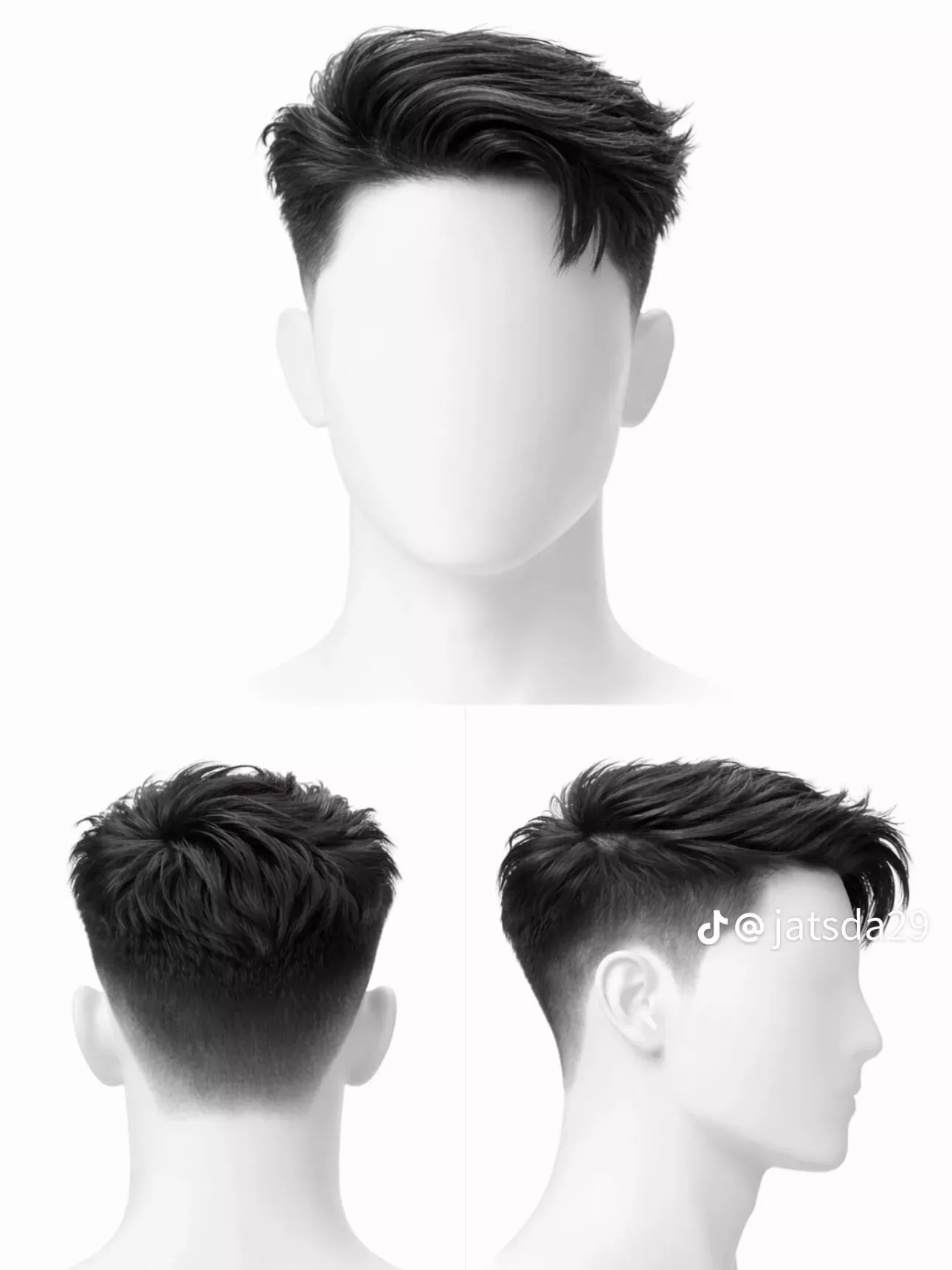
Low fade haircuts for men keep the shortest blend near the ears and lower hairline, retaining more weight through the upper sides than a high fade. They pair with textured crops, curly tops, quiffs, side parts and longer styles. The term low describes fade placement; you can still choose a subtle shadow finish or a close low skin fade.
The hairstyles below are independently written descriptions paired with existing site images. Exact fade terminology varies between barbers, so a side and back photo is the most reliable reference.
Quick Answer: Low Fade Haircuts for Men
The best version depends on your head shape, hair texture, the amount of side contrast you prefer and how often you plan to visit the barber. Fade height and shortest guard setting are separate decisions.
12 Low Fade Haircuts for Men With Photos and Barber Instructions
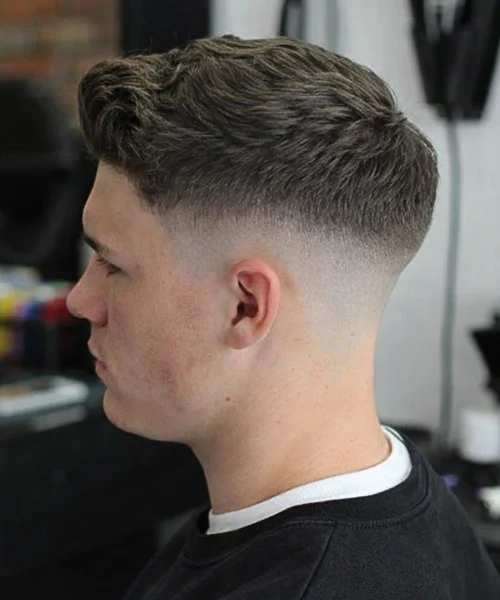
1. Low Fade French Crop

A forward textured crop creates a short practical top over a low blended side.
What to tell your barber: Leave the fringe at a comfortable dry length and keep the side fade below the temples.
Styling: Work with your natural hair texture on top and use only the product needed for your preferred finish.
2. Low Fade Side Part

A side part gives a cleaner, classic shape above a subtle low fade.
What to tell your barber: Follow the natural part and confirm whether you want a hard razor part.
Styling: Work with your natural hair texture on top and use only the product needed for your preferred finish.
3. Low Fade Textured Quiff

A textured quiff keeps lift in front while the side blend stays understated.
What to tell your barber: Leave enough front length and discuss how much styling the quiff needs.
Styling: Work with your natural hair texture on top and use only the product needed for your preferred finish.
4. Low Fade Curly Top

The lower fade exposes the curl texture while maintaining a balanced side silhouette.
What to tell your barber: Account for dry curl shrinkage and keep a softer line above the ears.
Styling: Work with your natural hair texture on top and use only the product needed for your preferred finish.
5. Low Fade Curtain Bangs

Medium curtains can soften the front while the lower sides stay tidy.
What to tell your barber: Retain sufficient fringe length to part and do not cut the upper sides too tight.
Styling: Work with your natural hair texture on top and use only the product needed for your preferred finish.
6. Low Fade Medium-Length Hair

A longer top offers brushed-back or layered styling over the same low fade.
What to tell your barber: Specify how much weight should remain above the blend.
Styling: Work with your natural hair texture on top and use only the product needed for your preferred finish.
7. Low Fade Pompadour

A pompadour adds front height while a low fade keeps the sides softly controlled.
What to tell your barber: Choose a realistic height and ask for enough front length.
Styling: Work with your natural hair texture on top and use only the product needed for your preferred finish.
8. Low Fade Slick Back

A slicked-back top contrasts with a neat but low side transition.
What to tell your barber: Retain the length needed to brush back comfortably.
Styling: Work with your natural hair texture on top and use only the product needed for your preferred finish.
9. Low Fade Undercut

A relatively distinct longer top with lower faded sides produces stronger contrast than a soft taper.
What to tell your barber: Confirm whether you want separation or a continuous blended transition.
Styling: Work with your natural hair texture on top and use only the product needed for your preferred finish.
10. Low Skin Fade Buzz Cut

A close buzz top combined with a low skin fade creates a minimal finish.
What to tell your barber: Agree on top guard length and where the skin finish begins.
Styling: Work with your natural hair texture on top and use only the product needed for your preferred finish.
11. Low Drop Fade With Messy Top

A curved low drop behind the ear gives shape to the neckline while the top remains loose.
What to tell your barber: Use a back photograph to show the drop curve.
Styling: Work with your natural hair texture on top and use only the product needed for your preferred finish.
12. Curly Fringe With Low Fade

A forward curly fringe makes a natural texture focal point.
What to tell your barber: Plan the dry curl length and keep the fade below the sides.
Styling: Work with your natural hair texture on top and use only the product needed for your preferred finish.
More Fade Haircut Photo Inspiration
Browse additional reference photos. Each image can be independently changed in the WordPress Gutenberg gallery.
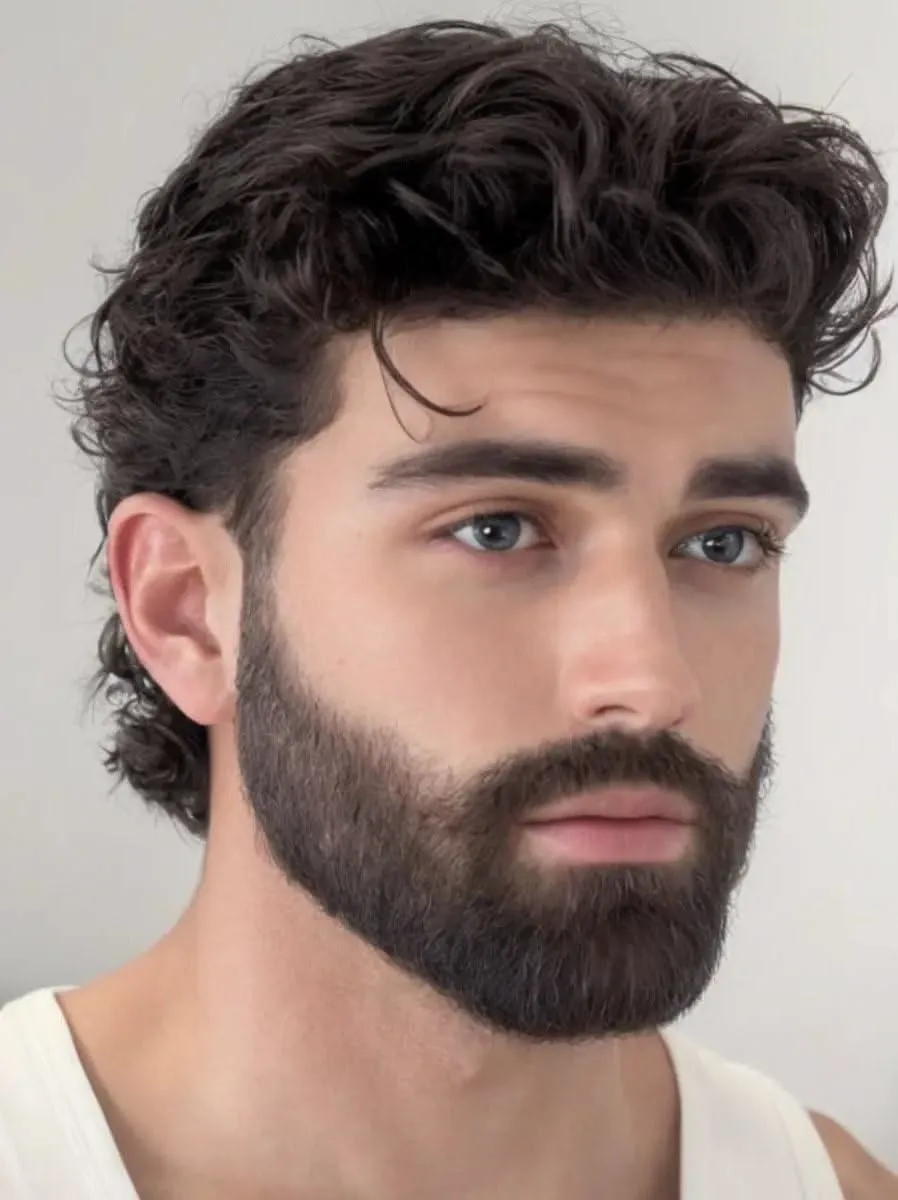



Low vs Mid vs High Fade: What Changes?
A low fade preserves more hair around the upper sides and looks relatively subtle. A mid fade moves the blend higher for more contrast. A high fade removes more upper-side length. A skin fade refers to how close the shortest section is, not its height.
Fade Haircuts for Straight, Wavy, Curly and Thick Hair
Straight hair makes a fade’s sharp outlines more noticeable; wavy hair provides soft movement above the blend; curly hair needs attention to shrinkage; and thick hair may require careful weight reduction above the transition. Explore straight haircuts, wavy hairstyles, curly hairstyles and thick hairstyles.
Fade Hairstyles for Indian Men and Different Face Shapes
Indian men have varied straight, wavy and curly hair patterns, so the right fade comes from texture and personal preference. Round, oval, square and long faces can all wear fades. The fringe height, top volume and side outline make more visual difference than a rigid face-shape rule. Compare our face shape guide.
Fade Haircut With Beard and Professional Styles
A side part with a gentle fade can be an understated professional hairstyle; a curly fringe or textured quiff can look more relaxed. If you have a beard, ask your barber how the fade should connect to sideburns. Explore our beard styles guide.
How to Ask Your Barber for a Fade
Show a front, side and back photo. Specify whether the blend is low, middle or high, and whether the shortest area should be skin, a close clipper guard or a darker shadow. Decide what to keep on top, how the fade connects around the ear and when you want the next maintenance trim.
Frequently Asked Questions
What is a low fade haircut?
It is a graduated blend that begins near the ears and lower sides, leaving more length farther up.
Is a low fade better than a mid fade?
Neither is universally better. A low fade is subtler; a mid fade exposes more of the side contrast.
Can a low fade work with long hair?
Yes, when the barber preserves longer top or upper side hair and places the transition low.
Does a low fade work with curly hair?
Yes. Curls can stay longer on top, with a low blend around the sides.
What is the difference between low taper and low fade?
A low taper often focuses around sideburns and the neckline, while a low fade usually blends a larger side section. Terms vary by barbershop.
Related Men’s Haircut Guides
Browse haircuts for men, short hairstyles, medium hairstyles and the hairstyle image gallery.